10. Tetris Effect
Monsters, Resonair, 2018. PC, PS4. Puzzle.
Since Rez on the Dreamcast, Tetsuya Mizuguchi has been chasing the goal of bringing synesthesia (where a single sensory stimulus produces a sensation in multiple senses) to the masses, or at least those who play video games. In Rez, he orchestrated visual images, music, controller input and vibration to affect all senses at once (except smell)—either through the controller or with a peripheral device only available in Japan but that could be inserted, well, wherever one chose.
Utilising the hypnotising visual repetition of one of the most universally mesmerising games of all, Tetris, Mizuguchi was able to make manifest the visual hallucinations of avid Tetris players in virtual reality.
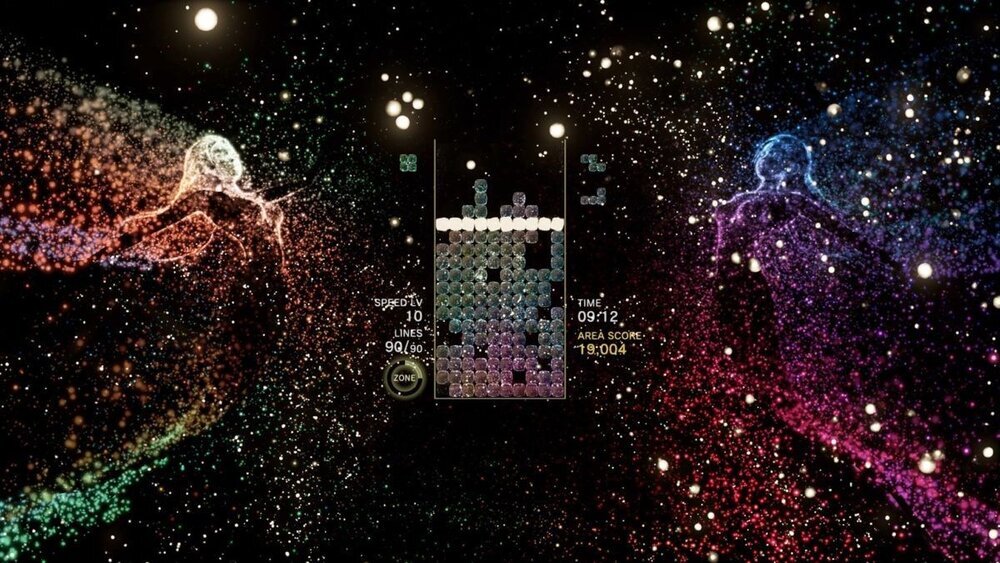
The Playstation 4 VR headset has outsold all other 3D headsets.
Even without the full body vibration suit that was available to the press, Tetris Effect won game of the year awards for the experience itself, but for this list it carries the additional honour of representing the rise (albeit followed by the plateau) of virtual reality. The progression of virtual reality continues to be invested in as the decade fades with multiple hardware and software developers committed to the concept, and it has at least outlived the 3D fad perpetuated by television manufacturers. While perhaps being influential only for the number of Playstation VR kits it sold, it none-the-less represents the most successful progression of virtual reality to date in the gaming world (sorry Nintendo Labo[cardboard VR is way cooler, though-Tom Towers]).
- Phil Fogg
9. The Walking Dead
Telltale Games, 2012. Most Platforms. Graphic Adventure.Companies like LucasArts and Sierra had great success with the adventure game genre for almost two decades before losing the interest of English-speaking gamers. Games like King’s Quest, The Secret of Monkey Island and Space Quest mixed puzzle solving and exploration, often with writing that drew on the imagination and good humour of players, just as the text adventure games that provided their foundation did.
About ten years after the decline of the genre, a small group of developers formed Telltale Games with the goal of serving the loyal fans of the genre who were asking for a return to the heyday of “point and click” adventure games. After a modest start with Sam and Max that proved there was still a niche audience for adventure games, Telltale finally found mainstream success by making a game based on The Walking Dead licence. While building on the structure of adventure games—explore an area, solve puzzles (in the case of The Walking Dead that means pixel hunt) before moving to the next area—instead of motivating the player with the new area they discovered once they've solved the puzzles in the current area, they were rewarded with the next development of the soap opera-style story, in which they were able to select dialogue choices that would in differing degrees change the path of the plot.

Like Tim Schafer, Adventure game aficionado and site co-founder, Tom “ESC Room” Towers, has always found adventure games to be about the setting more than the story/characters/dialogue (which are nevertheless usually of interest in and of themselves), while people who don't play adventure games tend to think they're about the story and the characters. The Walking Dead, by focusing on story and characters over setting and puzzles, became what the average non-adventure game player thought adventure games were, and thus was an adventure game with mass appeal for the first time since the days of Grim Fandango. This broad appeal and passive gameplay led to phenomenal commercial and critical success, enabling Telltale to drag its broken game engine throughout the world of immoral-licence, making games for any company that would lend a brand. (ED: Sadly at the time of Telltale’s demise, The Game Under Podcast was in advanced talks to develop, The Game Under Podcast: The Telltale Series in which Phil Fogg and Tom Towers journey on foot across a near-future dystopian Australia).

Beyond games that Telltale would make itself, the influence of The Walking Dead can be seen in a myriad of other puzzle-less, story instead of setting, adventure games, such as Life is Strange. Even other genres started to use player-choice as a component of their story telling, and while the episodic mode of distribution was ultimately abandoned, it was adopted by many developers as a way to sustain funding during development by selling a game in several smaller-priced instalments, at least until crowd-funding and early access became easier sources of income. The episodic release schedule added more than funding though, it lent to a true cultural phenomenon, generating conversation and anticipation (not to mention word of mouth marketing) around the release of each episode.
- Phil Fogg
8. Depression Quest
The Quinnspiracy, 2013. PC. Interactive Fiction.
Outside of sporting organisations, religions and political parties there are few “communities” as passionate and squeamish as enthusiast gamers. Gamers really, really love games. And gamers, really, really hate those who love games in ways they do not. The religious zeal with which gamers debate what games they love and hate is why I find the gaming “scene” (lol) so endlessly fascinating. There is no greater worship of the arbitrary achievements of human creativity today than the church of gaming and, personally, I find a world without arbitrary creativity to be, counterintuitively, completely and utterly pointless.
However, evangelical passion is tremendously easy to manipulate (creating and spreading it is the hard part). Console manufacturers and videogame publishers were the first entities to turn previously unbridled nerd rage into grassroots marketing by fanning the flames of the console wars, turning fanboys into guerrilla marketers—a tremendously important strategy before the internet when word on the street was just as important as magazine reviews, or YouTube “influencers” and witty astroturf tweets are today. The likes of Steve Jobs and Elon Musk stand out in other markets, but cultish propaganda strategies building a brand on the zealous proselytising of its own consumers are par for the course in gaming.

Last decade—only two or three hundred years after Romanticism killed God and secular humanists began to invent new religious structures based on art, science and the occult—the evangelical atheist movement suddenly realised God no longer existed. Simultaneously, some two-hundred or three-hundred years after the height of molly houses and women masquerading (often unnoticed) in public as men, liberals suddenly realised crossdressing was a thing that occurred outside of TV comedies.
Next minute and gaming forums were overrun with the dogmatic atheist mind virus and feminist cooties, the former mainly just taking every opportunity to make straight-faced, acerbic responses to Christians arguing that God existed because bananas came pre-wrapped by nature in condoms, allowing for safer insertion into the mouth; the latter just kinda calling for more female characters in games. But some atheists dabbled in running a cheer squad for wars of aggression and torture because their targets were Muslims—that the war criminals and torturers they were defending were Christians acting on the righteous instruction of God, didn’t seem to matter for some reason. And some feminists didn’t really like that games featured penises, believing that the biologically-superior penis was kryptonite to the biologically-inferior vagina (as you can tell from this, their understanding of pop culture was questionable: Superman may have had one crippling weakness, but was otherwise essentially invincible; whereas their vision of an archetypical woman was someone who could not only be torn asunder by a soft sack of skin filled with blood, but was also utterly incapable of dealing with day to day life).

Oh, and then the economy crashed. Five years of stagnation later, and Depression Quest was released. A free browser-based game, you could also choose to pay-what-you-wanted, with part of the proceeds going to the suicide prevention hotline. It was a critical success, and other than a few voices in the gaming community who were annoyed that a game about a serious topic like depression existed, no one really objected. Then a jilted ex-boyfriend of Zoe Quinn (the mastermind behind Depression Quest) decided to slutshame her; accusing her of having once cheated on him (of course the anti-cuck crowd’s hero would literally be a cuckold) with a games critic who gave Depression Quest a positive review.
If there’s one thing gamers can’t stand, it’s critical bias—and other people, especially women, having more sex than they do. The idea that critics and game developers who have intermittent contact might end up engaging in more intimate intercourse than sending and receiving press releases was incomprehensible and morally outrageous to gamers. And so, somehow, out of a cuck slutshaming the woman who cucked him grew a crusade against corrupt games critics.
This crusade then began to slowly but surely mutate into a massive reactionary political movement (though one might argue that a slutshaming, sex-negative, anti-social justice cultural movement was probably reactionary to begin with), laying the foundations of structural communication for dissident right-wing political movements in the internet age (from gamers who are just annoyed that games no longer market themselves towards a limited demographic, to activists who dox and harass people, to terrorists who like to shoot people) as well as strategies for internet disruption and harassment. It also influenced the language and cultural and political discourse that has spread all over the internet, building on the propaganda techniques of atheist takedown videos and people who didn’t realise Angry Video Game Nerd was a parody, altering not just the discourse of gaming communities, but all cultural and political commentary—from memes to social media algorithms to talking heads on the television. In response, games critics weaponised the penis; not realising that, in reality, penises are utterly harmless—even Superman’s!
Depression Quest itself may have been relatively unremarkable (Tom was unimpressed by it when he reviewed it on the show and Phil not only couldn’t be bothered playing it, he doesn’t even remember Tom talking about it!) but the political movement it inadvertently spawned is arguably the biggest mainstream cultural impact gaming has ever had, surpassing that even of the Wii!

Bonus Backstory: Harvard-Educated Leninist and Goldilocks Saxon, Steve “Mercer” Bannon once ran a gold-mining business in World of Warcraft using Chinese Labour—back then he was a little more iffy on the whole trade war thing. It was during such humble blue-collar beginnings (growing up on a farm in World of Warcraft, not going to Harvard and working as a Golden Sacks bagman, obviously) that he first realised the reactionary potential of gamers. Without him, among others, coming to this realisation, GamersGate may never have grown so big. But it’s easy for any grifter to make such claims in hindsight. I, on the other hand, observed such things at the time—as evidenced in my GameSpot blogs. Unfortunately, GameSpot deleted them all. But if you can believe that a Harvard-Educated Leninist Gold-spooned Saxophonist shilling for the Mercers is fighting for oppressed gamers, you should have no trouble believing me—admittedly I own Telstra shares but that, if anything, just shows you how bad of a businessman I am; I’m practically Trump!
Fuck Ace Watkins. Tom Towers 2020!
- Tom Towers